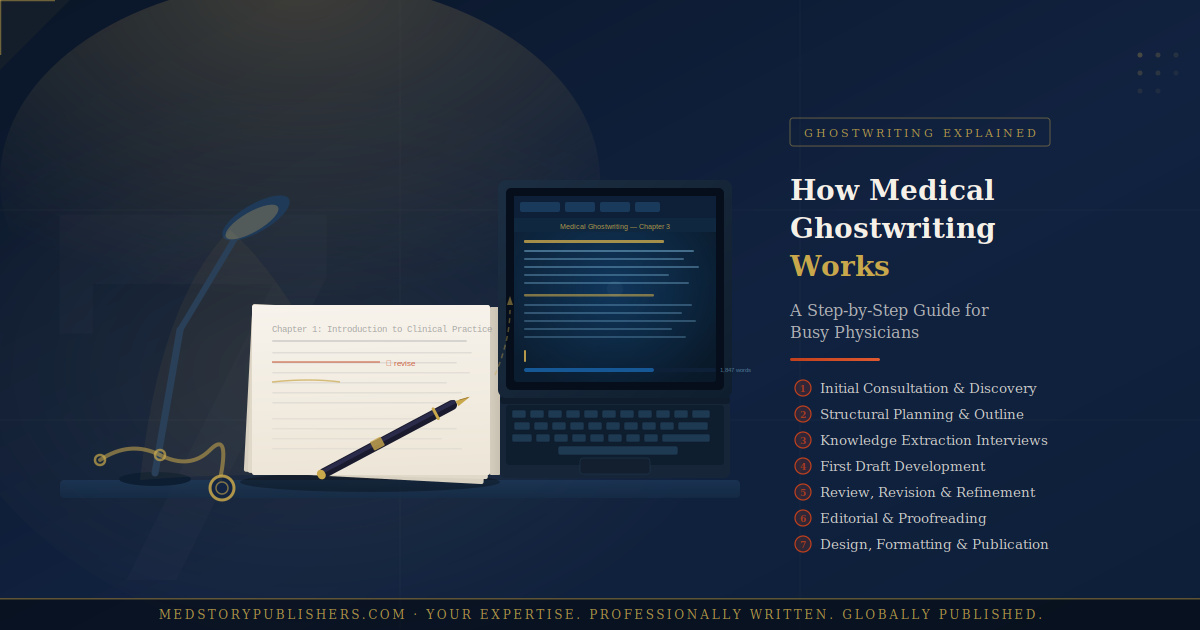
How Medical Ghostwriting Works: A Step-by-Step Guide for Busy Doctors
Published: April 2026 | Reading Time: 8 Minutes | medstorypublishers.com
You have spent years perhaps decades building clinical expertise that could genuinely help other physicians, students, or patients. You know you should write a book. You may have even started. But between hospital rounds, patient consultations, research commitments, and personal life, the manuscript never progresses beyond a few scattered notes.
This is the reality for most practicing physicians. Time is the one resource that no medical career has in surplus. That is precisely why medical ghostwriting services have become an essential and increasingly respected tool in healthcare publishing. Ghostwriting does not replace your knowledge or your voice, it gives your expertise the infrastructure it needs to reach the world.
This guide explains exactly how the medical ghostwriting process works, step by step, so you can make an informed decision about whether it is right for your book.
What Is Medical Ghostwriting?
Medical ghostwriting is the professional practice of a skilled writer producing a book, article, or other content on behalf of a physician or healthcare professional. The physician is listed as the author. The ghostwriter's name does not appear on the cover. The content, ideas, clinical insights, and authority behind the book remain entirely the physician's own.
This is not a new or controversial concept. Ghostwriting has a long history in publishing, politics, business, and academia. For busy physicians, it is a practical solution to a straightforward problem: you have the knowledge, but not the hours required to transform that knowledge into a structured, well-written, publishable manuscript.
Importantly, a professional medical ghostwriting service does not invent ideas, fabricate clinical evidence, or create content from nothing. The ghostwriter's role is to listen, extract, organise, and articulate what you already know in a format that serves your readers.
Is Medical Ghostwriting Ethical?
This is the question most physicians ask first, and it deserves a direct answer. Yes, medical ghostwriting is widely considered ethical when practised transparently and responsibly. The key principles are straightforward:
-
The physician provides the ideas, clinical knowledge, and direction. The ghostwriter is a writing professional, not a medical expert fabricating content.
-
No clinical facts are invented. All content is based on the physician's expertise, existing evidence, and verified sources.
-
The physician reviews and approves all content. Nothing is published without the author's full knowledge and sign-off.
-
Authorship is genuine. The physician is the intellectual author. The ghostwriter is the writing collaborator.
Major medical publishers, journals, and professional bodies across the world recognise and accept ghostwritten works, provided the authorship criteria are met. If you are still uncertain, it is worth discussing the matter with your institution or professional body before proceeding.
The Step-by-Step Medical Ghostwriting Process
Every medical ghostwriting project at MedStory Publishers follows a structured, collaborative process designed specifically for busy healthcare professionals. Here is how it works from first contact to final manuscript.
Step 1: Initial Consultation and Discovery
The process begins with an in-depth consultation between you and your assigned ghostwriter. This is not a brief intake form it is a genuine conversation, typically lasting one to two hours, designed to understand:
-
Your book concept, core message, and clinical focus
-
Your target audience — fellow specialists, primary care physicians, patients, or students
-
Your existing materials — lectures, research papers, case notes, or presentation slides
-
Your preferred writing style and tone
-
Your publishing goals — traditional publishing, self-publishing, or institutional distribution
This discovery phase is the foundation of the entire project. The more clearly your vision is articulated here, the more authentically the ghostwriter will capture your voice throughout the manuscript.
Step 2: Structural Planning and Outline
Once your vision is understood, the ghostwriter develops a detailed chapter-by-chapter outline. This document maps the full arc of your book, from introduction to conclusion and identifies the key arguments, clinical evidence, case studies, and supporting material each chapter will contain.
You review and approve the outline before any writing begins. This is a critical quality checkpoint. Adjustments at the outline stage are simple and cost no time. Adjustments mid-manuscript are far more complex. A well-approved outline ensures the finished book reflects exactly what you intended.
Step 3: Knowledge Extraction Interviews
This is the stage that distinguishes a professional medical ghostwriting service from a generic content agency. Your ghostwriter conducts a series of structured interviews usually conducted remotely by video or phone, scheduled around your clinical commitments to extract the specific knowledge, perspectives, and clinical narratives that will form the book's substance.
These interviews are recorded (with your permission) and transcribed. The ghostwriter identifies the most compelling insights, the clearest explanations, and the most powerful clinical stories from your conversations. Your language, your phrasing, and your instinctive way of explaining complex ideas become the raw material for the manuscript.
Step 4: First Draft Development
With the outline approved and the interview material gathered, the ghostwriter begins writing the manuscript. Depending on the scope of the project, a full first draft typically takes between six and twelve weeks.
Throughout this stage, the ghostwriter may submit individual chapters for your review rather than waiting until the full draft is complete. This rolling review approach allows you to give feedback early, correct any misrepresentations of your clinical position, and keep the project moving without disrupting your schedule. You are never expected to review hundreds of pages at once.
Step 5: Review, Revision, and Refinement
Once you receive the draft whether chapter by chapter or as a complete manuscript you provide detailed feedback. Your ghostwriter incorporates your revisions and returns a refined version. This revision cycle typically continues for two to three rounds until the manuscript fully reflects your voice, your clinical knowledge, and your publishing vision.
At MedStory Publishers, revision rounds are included as standard. You will never be charged extra for requesting changes; it is your book, and it must be right.
Step 6: Editorial and Proofreading
Once the manuscript is approved, it enters a dedicated editorial phase. A professional medical editor reviews the content for clarity, consistency, clinical accuracy, and readability. A proofreader then conducts a final pass to eliminate typographical errors, grammatical inconsistencies, and formatting issues.
This editorial stage is what separates a professionally produced medical book from a self-edited manuscript. It is not optional, it is the difference between a book that commands professional credibility and one that undermines it.
Step 7: Design, Formatting, and Publication
With a polished, approved manuscript, the project moves into design and production. This includes interior book layout, cover design, ISBN registration, and preparation for print and digital distribution. Your publishing team at MedStory Publishers manages the entire production process, including submission to global distribution platforms so your book is available to readers worldwide.
How Long Does Medical Ghostwriting Take?
The timeline varies by project scope, but a typical medical book follows this general schedule:
-
Discovery and outline: 2 to 3 weeks
-
Knowledge extraction interviews: 2 to 4 weeks
-
First draft: 6 to 12 weeks
-
Revision rounds: 3 to 6 weeks
-
Editorial and proofreading: 2 to 3 weeks
-
Design and production: 3 to 5 weeks
In total, most medical books move from initial consultation to a print-ready manuscript within five to seven months. Expedited timelines are available for physicians with specific publication deadlines.
What Makes a Good Medical Ghostwriter?
Not every writer is equipped to ghostwrite a medical book. The best medical ghostwriters combine several distinct capabilities:
-
Scientific literacy. They must understand clinical terminology, research methodology, and evidence-based practice well enough to write accurately without misrepresenting your expertise.
-
Interviewing skill. The ability to extract clear, structured knowledge from complex clinical conversations is a specialised craft.
-
Voice adaptation. A skilled ghostwriter disappears into your perspective. The finished book should read as if you wrote every word yourself.
-
Publishing knowledge. Understanding what makes a medical book commercially viable and editorially strong is essential for producing a manuscript that will be taken seriously.
At MedStory Publishers, all ghostwriters are matched to projects based on their specific medical speciality background, ensuring your book is written by someone who already speaks your professional language.
Who Is Medical Ghostwriting Right For?
Medical ghostwriting is the right solution for any physician or healthcare professional who:
-
Has a clear book idea but lacks the time to write it
-
Has started a manuscript but stalled and cannot see a path to completion
-
Has extensive lecture notes, research papers, or clinical guides that need shaping into a book
-
Wants to build professional authority, attract speaking engagements, or reach a broader audience
-
Is approaching retirement and wants to preserve their clinical legacy in a lasting format
If any of these descriptions apply to you, a medical ghostwriting consultation with MedStory Publishers is the logical next step.
Conclusion: Your Knowledge Deserves to Be Published
Medical ghostwriting is not a shortcut, it is a professional collaboration that honours the depth of your expertise by giving it the time, structure, and writing quality it deserves. The process is transparent, ethical, and specifically designed for the demands of a practising physician's life.
Your clinical knowledge has taken years to develop. The patients, students, and practitioners who could benefit from it deserve more than scattered notes on a hard drive. A professionally ghostwritten medical book puts your expertise into permanent, accessible, credible form and it does so without consuming the clinical time you cannot afford to lose.