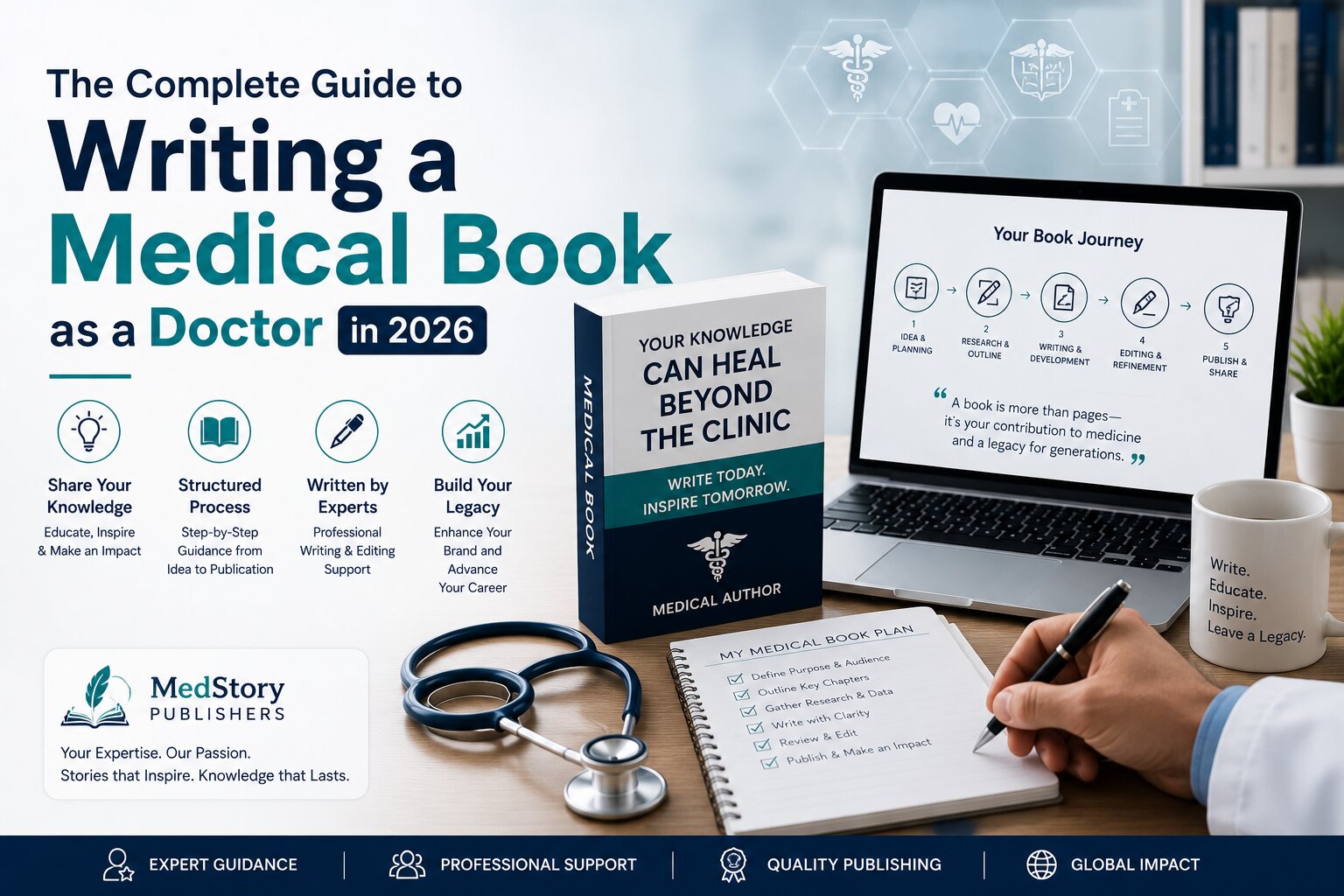
The Complete Guide to Writing a Medical Book as a Doctor in 2026
A comprehensive overview of the entire book-writing journey for physicians: planning, writing, publishing, and distributing a medical book.
Introduction: Why Every Doctor Has a Book Worth Writing
You have spent years, perhaps decades, inside examination rooms, operating theaters, and hospital corridors, accumulating something no algorithm can replicate: lived clinical wisdom. You have seen patterns no textbook captures. You have had conversations with patients that changed the way you practice medicine. You have developed perspectives on your specialty that your colleagues admire and your patients depend on.
That body of knowledge deserves a wider audience.
In 2026, writing a medical book is no longer a luxury reserved for department chairs at Ivy League institutions. Advances in self-publishing, digital distribution, and print-on-demand technology has democratized authorship entirely. A board-certified internist in Kansas City has the same publishing infrastructure available to her that a Harvard professor had to fight for thirty years ago.
What separates those who publish from those who merely intend to is not talent, pedigree, or free time. It is a clear, step-by-step process.
This guide gives you exactly that: a practical roadmap covering every phase of the medical book-writing journey, from clarifying your purpose and planning your content to drafting chapters under clinical time constraints, navigating the publishing landscape, and getting your finished book into the hands of readers who need it most.
Whether you want to educate patients, cement your professional authority, share hard-won specialty knowledge with fellow clinicians, or leave a lasting legacy, this guide will show you how.
Part 1: The Strategic Foundation – Why, What, and Who
Defining Your Purpose Before You Write a Word
The single biggest reason physician authors abandon book projects midway is that they never clearly define why they are writing in the first place. Purpose is the engine that keeps you returning to the manuscript on a Tuesday night after a twelve-hour shift.
Before you open a document or outline a chapter, answer these four questions honestly:
1. What is the primary goal of this book?
Medical books typically serve one of several purposes:
- Patient education – Helping patients and the general public understand a condition, treatment, or preventive lifestyle strategy in plain language.
- Professional authority – Positioning yourself as a thought leader in your specialty.
- Clinical education – Teaching students, residents, or fellow practitioners an evidence-based approach.
- Personal legacy – Sharing your life in medicine through memoir or narrative nonfiction.
- Institutional goals – Supporting hospital branding, academic promotion, or practice growth.
2. What unique insight can only you provide?
You are not writing an encyclopedia. You are writing your book. What perspective, patient population, or experience makes your voice valuable?
3. Who is your ideal reader?
A patient education book for newly diagnosed diabetics reads differently than a surgical handbook for residents. Define your reader clearly.
4. What does success look like one year after publication?
Success might mean:
- 1,000 copies sold
- Speaking invitations
- Increased referrals
- Academic credibility
- A personal legacy for your family
Clarity about outcomes shapes every decision that follows.
Choosing the Right Book Format
Patient-Facing Health Books
Accessible, empathetic, practical books for general readers.
Clinical Reference Books
Written by clinicians for clinicians. Often highly technical.
Academic and Research-Based Books
Evidence-heavy books designed for universities, institutions, and scientific audiences.
DR’s Memoir
Popularized by authors like Atul Gawande, Paul Kalanithi, and Siddhartha Mukherjee, memoirs combine authority with storytelling.
Hybrid Books
A mix of education + personal stories. Often ideal for doctors.
Validating Your Book Idea Before You Invest Time
Before committing months of effort:
- Search Amazon for similar titles
- Read negative reviews of competing books
- Ask patients what confuses them most
- Ask colleagues what resource they wish existed
- Use search trends tools to gauge demand
If demand is clear and gaps exist, move forward confidently.
Part 2: Planning Your Medical Book
Creating a Strong Outline
Experienced authors agree: time spent outlining saves months later.
Build a Macro Outline
10 to 15 chapters covering the reader journey.
Build a Micro Outline for Each Chapter
Include:
- Main lesson
- 3 to 5 supporting points
- Stories or case studies
- Research or citations
- Reader takeaway
A strong outline turns writing into execution.
Setting a Realistic Word Count
| Book Type | Typical Word Count |
| Patient education guide | 30,000 to 50,000 |
| Memoir | 60,000 to 90,000 |
| Clinical guide | 50,000 to 120,000+ |
| Academic text | 80,000 to 200,000+ |
For most first-time physician authors, 40,000 to 60,000 words is ideal.
Building a Writing Schedule That Fits Clinical Life
Doctors rarely have huge free blocks of time.
Instead:
- Write 30 to 45 minutes consistently
- Protect your peak energy window
- Set weekly word goals
- Use dictation apps while commuting
A goal of 1,500 words weekly can produce a 60,000-word manuscript in under a year.
Part 3: Writing the Manuscript
Start Strong
Your opening chapter must make readers feel:
- This book is for me
- This doctor understands me
- This book will help me
The best openings begin with story:
- A patient encounter
- A difficult diagnosis
- A surgical complication
- A life-changing conversation
Story creates emotional investment.
Write Chapters That Are Rigorous and Readable
Use the Evidence + Narrative Method
Tell a patient story, explain the science, then return to the story.
Lead With the Main Insight
Readers are busy. Put the most valuable lesson first.
Use Plain Language
Especially for patient books.
Maintain Human Voice
Avoid sounding like a journal article.
Write like you speak to a patient when you truly want them to understand.
Citations, Accuracy, and Ethics
Clinical Books
Use proper references and current guidelines.
Patient Books
Use simplified references in notes sections.
Memoirs
Factual claims should still be accurate.
Privacy Matters
- Protect patient identity at all times.
- Change details or obtain written permission.
- This is non-negotiable.
Part 4: Publishing Options in 2026
Traditional Publishing
In this model, an author submits a manuscript or book proposal to a publishing company, and if accepted, the publisher invests in producing, distributing, and selling the book.
Pros
- Prestige
- Distribution
- Professional team
- Advance payments
Cons
- Highly competitive
- Slow timelines
- Lower royalties
- Less control
Hybrid Publishing
You pay for services but keep rights and higher royalties.
Best For
Doctors who want quality + speed + ownership.
Self-Publishing
Platforms like Amazon KDP and IngramSpark allow full independence.
Pros
- Highest royalties
- Fastest launch
- Full control
Cons
- Must manage quality
- Must market yourself
Part 5: Professional Editing – Non-Negotiable
No physician should publish a self-edited manuscript.
Developmental Editing
Fix structure, logic, chapter flow.
Line Editing
Improve clarity and style.
Copyediting
Grammar, punctuation, consistency.
Medical Accuracy Review
Especially critical for clinical books.
Proofreading
Final quality control before launch.
Part 6: Design and Production
Cover Design
Readers judge books by covers.
A professional cover signals:
- Trust
- Quality
- Relevance
- Authority
Interior Formatting
Important for:
- Tables
- Charts
- Clinical diagrams
- Print layouts
- eBooks
Formatting mistakes delay launches.
Part 7: Distribution and Marketing
Where to Sell
- Amazon
- Your clinic website
- Waiting rooms
- Medical associations
- Universities
- Conferences
Build an Author Platform
Use:
- YouTube
- Speaking engagements
- Podcast interviews
Effective Launch Strategies
- Collect early reviews
- Build an email list
- Run a launch campaign
- Use keyword-optimized descriptions
- Pitch media outlets
Part 8: Working With Medical Book Professionals
Why Doctors Hire Ghostwriters
Many successful doctors do not write books alone.
Professional collaborators help by:
- Conducting interviews
- Organizing expertise
- Writing in your voice
- Saving time
- Maintaining momentum
The doctor remains the credited author.
Choosing the Right Publishing Partner
Evaluate based on:
- Medical industry understanding
- Editorial quality
- Portfolio strength
- Confidentiality
- Marketing support
- Ownership of rights
Conclusion: Your Knowledge Has a Shelf Life
Medicine evolves. Guidelines change. Clinical wisdom can disappear when it is never documented.
A doctor who writes a book creates a permanent asset that can educate and inspire long after retirement.
The barriers in 2026 have never been lower.
Start with purpose. Build a plan. Write consistently. Invest in professionals. Publish with excellence.
Your patients, your colleagues, and your legacy are waiting for the book only you can write.
About MedStory Publishers
At MedStory Publishers, we have helped over 2,800 healthcare professionals transform their expertise into professionally published books since 2008.
From medical ghostwriting and editing to cover design, formatting, global distribution, and marketing, we handle the full journey so you can focus on what you do best: saving lives.
Ready to start your medical book project? Get your free expert consultation today.